
How Smartwatches Are Changing Your Health: Benefits, Accuracy & Future
Introduction
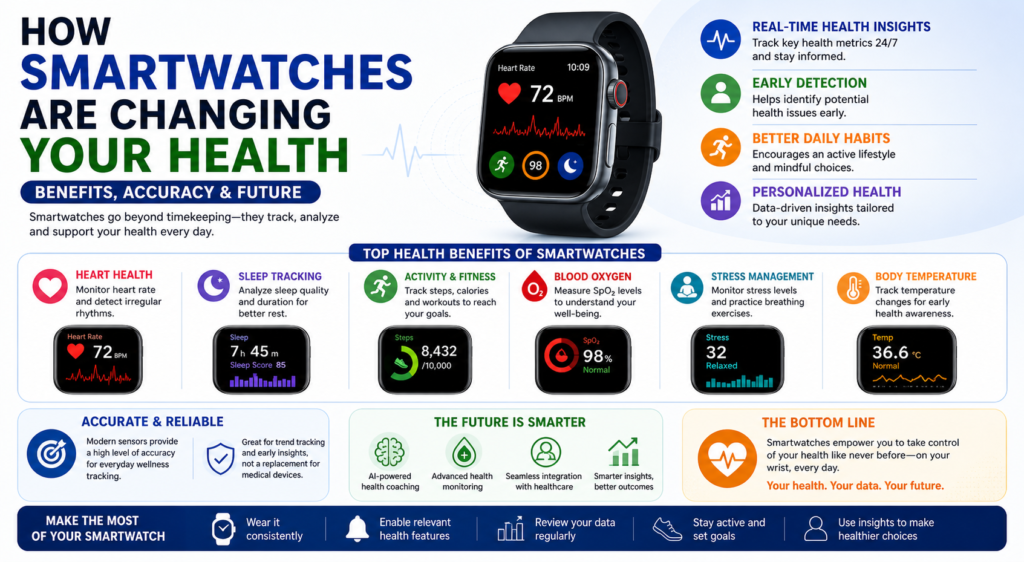
Smartwatches have expanded beyond basic step counting and notifications. But today ,They now offer a range of health and fitness measurements—a convenient way to monitor selected health and activity metrics. Many people now start their day by checking sleep scores or tracking their heart rate during workouts. In fact, for some users, a smartwatch is the first place where they notice something unusual about their health. With advanced sensors and AI-powered insights, smartwatches are helping people understand their bodies better, detect early warning signs, and stay more active in daily life.
What Is a Smartwatch?
A smartwatch is a wearable device that connects to your smartphone and provides features like notifications, fitness tracking, and health monitoring.
Popular options include:
- Apple Watch
- Samsung Galaxy Watch
- Fitbit
These devices are designed to give real-time insights into your body, making it easier to track your health without visiting a clinic every day.
1. Heart Rate Monitoring & Early Detection
Modern smartwatches continuously track your heart rate throughout the day—even when you are resting.
Why this matters:
- Detect abnormal heart rate patterns
- Identify early warning signs
- Improve workout efficiency
Many users report noticing unusual spikes or drops in heart rate through their watch before feeling any symptoms. While it doesn’t replace medical tests, it can act as an early alert system.
2. Sleep Tracking & Better Rest
Sleep is often ignored until it starts affecting your energy and mood. Smartwatches help you understand what’s happening while you sleep.
If your watch repeatedly shows poor sleep quality, understanding how sleep affects recovery can help you build a better routine.
What they track:
- Deep sleep
- Light sleep
- REM cycles
Many people believe they sleep 7–8 hours, but smartwatch data often reveals frequent interruptions or poor sleep quality. This awareness alone helps users make small changes like reducing screen time before bed or improving sleep schedules.
3. Fitness Tracking & Daily Motivation
Smartwatches act like a silent fitness coach that keeps reminding you to stay active.
Tracking daily movement can also support long-term weight-management goals when combined with a balanced diet.
Features include:
- Step counting
- Calories burned
- Workout tracking
One practical benefit is motivation.
Seeing daily progress—even something simple like reaching 8,000 steps—can push people to stay consistent.
4. Blood Oxygen & Stress Monitoring
If your stress readings regularly coincide with mental exhaustion, simple daily habits can help support mental well-being.
Advanced smartwatches now track:
- Blood oxygen levels (SpO2)
- Stress levels
Why this is useful:
- Helps monitor breathing efficiency
- Gives insight into stress patterns
Some users notice higher stress levels during work hours, which helps them consciously take breaks or practice relaxation techniques.
5. Are Smartwatches 100% Accurate?
This is one of the most important questions.
The answer is: No, but they are still useful.
Limitations:
- Slight variations in readings
- Not a medical-grade device
- Data can fluctuate daily
Important perspective:
Smartwatches are best used to track trends over time, not exact numbers. For example, a consistently high heart rate trend matters more than a single reading.
6. Role of Artificial Intelligence in Smart Health Tracking
Modern smartwatches are powered by Artificial Intelligence, which turns raw data into useful insights.
What AI does:
- Provides personalized health suggestions
- Detects unusual patterns
- Recommends fitness improvements
Instead of just showing numbers, AI helps answer:
“What does this mean for my health?”
7. Hidden Benefits Most People Don’t Realize
Small improvements in daily activity work even better when supported by nutritious meals that provide steady energy.
Beyond basic tracking, smartwatches offer benefits that many users overlook:
1. Behavior awareness
You become more conscious of your habits—sleep, activity, and even stress.
2. Micro-improvements
Small changes like walking more or sleeping earlier add up over time.
3. Reduced sedentary lifestyle
Reminders to stand or move can reduce long sitting hours. These small improvements often lead to long-term health benefits, even without drastic lifestyle changes.
8. Future of Smartwatches in Healthcare
The future of wearable health technology is evolving rapidly. Upcoming features may include:
- Non-invasive blood sugar monitoring
- Early disease detection
- Real-time emergency alerts
Smartwatches may soon become a first line of health monitoring, especially for early detection.
Tips to Use Smartwatches Effectively
To get the best results:
- Don’t rely completely on data
- Use it as a guide, not a diagnosis
- Focus on long-term trends
- Combine it with a healthy lifestyle
Think of a smartwatch as a support tool, not a replacement for medical advice.
FAQs
1. Are smartwatches good for health?
Yes, they improve awareness by tracking fitness, sleep, and heart rate.
2. Can a smartwatch detect heart problems?
Some advanced devices can detect irregular patterns, but proper diagnosis requires medical tests.
3. Which smartwatch is best for health tracking?
Popular options include Apple Watch, Fitbit, and Samsung Galaxy Watch.
4. Do smartwatches help with weight loss?
Yes, they track activity and calories, helping users stay consistent with their fitness goals.
Conclusion
Smartwatches are changing the way people approach health—not by replacing doctors, but by making individuals more aware and proactive. From tracking heart rate to improving sleep habits, these devices provide daily insights that were once difficult to access. The real power of a smartwatch lies not in perfect accuracy, but in consistent awareness and small daily improvements.
Editorial Process
Our editorial process focuses on accuracy, clarity, and reader trust.
Health articles published on this website follow these principles:
- Research-based information from trusted medical sources
- Clear explanations written for general readers
- Regular updates when medical guidelines change
- Transparency about sources and references
Content is researched and written by health content researchers and reviewed using publicly available medical data.
Areas of focus include:
- infectious diseases
- preventive healthcare
- symptom awareness
- everyday health education
Medical Disclaimer
This article is for informational purposes only and does not replace professional medical advice. Always consult a qualified healthcare provider for diagnosis, treatment, or medical concerns.
Our Editorial & Trust Standards
At Healzeno, we aim to provide clear, responsible, and useful health information. Our content follows a structured editorial process:
Research → Writing → Fact-checking → Source verification → Editing → Publication → Periodic review
We aim to:
- Use reliable medical and public-health sources
- Avoid unsupported or misleading health claims
- Clearly distinguish general information from professional medical advice
- Update articles when important information changes
- Correct factual errors when identified
Healzeno is an independent health-information website and is not a medical clinic, hospital, or medical practice.
Why Trust Our Health Content
Our health articles are created using evidence-based information from globally recognized medical organizations. Each article is carefully researched using publicly available guidelines, research publications, and educational materials from trusted institutions such as the Centers for Disease Control and Prevention, the Mayo Clinic, the Cleveland Clinic, and the World Health Organization. Our goal is to present medical information in simple, easy-to-understand language so readers can make informed decisions about their health.
