PCOS Diet for Weight Loss: A Practical Indian Approach That Actually Works
Introduction: Understanding PCOS Beyond Just Weight Gain
Polycystic Ovary Syndrome (PCOS) is often reduced to one issue—weight gain. But for most women, it goes much deeper than that. It affects:
- Hormones
- Metabolism
- Mood
- Energy levels
And most importantly, it changes how your body responds to food and exercise. This is why many women feel frustrated. You may be eating less, trying to stay active, and still not seeing results.
Here’s :
PCOS is not just a calorie problem—it’s a hormonal imbalance.
In India, where food is emotional, cultural, and social, following extreme diets often feels impossible. The good news?
You don’t need to give up your traditional food.
You just need to eat smarter, not less.
“Healing is not about restriction, it’s about nourishment.”
How Diet Impacts PCOS and Weight Loss
PCOS is closely linked to insulin resistance, where the body struggles to use insulin properly.
Managing blood sugar is also important beyond PCOS, particularly because early changes in blood sugar regulation can sometimes go unnoticed.
For women following a vegetarian diet, getting enough protein can help make meals more satisfying while supporting muscle maintenance.
What happens then?
- Blood sugar levels rise
- Fat storage increases (especially belly fat)
- Weight loss becomes difficult
Studies suggest that improving insulin sensitivity can significantly help manage PCOS symptoms.
Belly fat can be particularly frustrating when hormonal and metabolic factors are involved.
It’s not about eating less food
It’s about eating the right type of food at the right time
When your meals are balanced:
- Energy stays stable
- Cravings reduce
- Hormones function better
Building an Indian Diet That Actually Supports PCOS
Let’s clear a myth:
“PCOS diet means salads and boiled food”
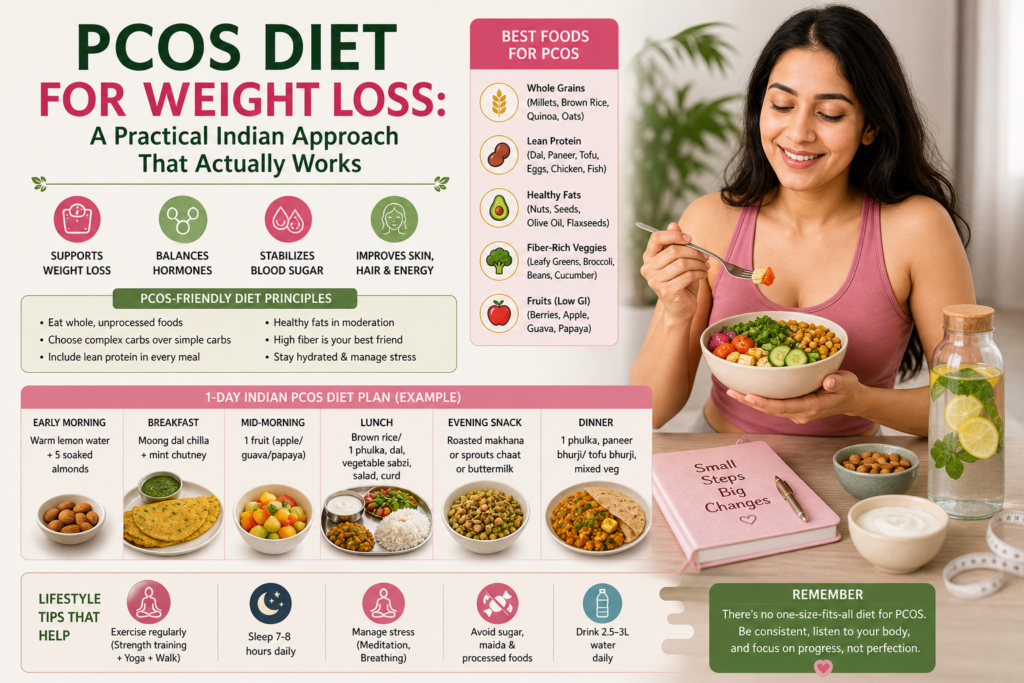
Reality: Your regular Indian food can work—if balanced properly
Gut-friendly foods can also be included as part of a balanced eating pattern rather than relying on restrictive diets.
What your plate should look like:
- Whole grains (roti, brown rice, millets)
- Protein (dal, paneer, eggs, legumes)
- Healthy fats (ghee in moderation, nuts, seeds)
- Fiber (vegetables, salads)
Simple meals like dal, sabzi, roti can be powerful when eaten mindfully.
The Comeback of Millets
Traditional grains like:
- Bajra
- Jowar
- Ragi
are now being recognized again for their benefits.
Experts believe millets help:
- Improve insulin sensitivity
- Keep you full longer
- Support weight management
This isn’t a new trend—it’s something our grandparents already knew.
Real Insight:
Many women with PCOS skip meals thinking it will help lose weight.
But this often backfires:
- Blood sugar crashes
- Cravings increase
- Overeating later
The Role of Meal Timing (Highly Underrated)
Most people focus only on what to eat. But with PCOS, when you eat matters just as much.
What works:
- Fixed meal timings
- No long gaps between meals
- Early dinner (2–3 hours before sleep)
Experts suggest that consistent eating patterns help regulate metabolism and hormones.
Smart Daily Swaps (Easy & Practical)
You don’t need a complete diet change. Start small:
- Replace sugary drinks → herbal tea or lemon water
- Replace biscuits → nuts or roasted chana
- Replace packaged snacks → homemade options
These small swaps may feel minor, but over time they create real transformation
Real-Life Example
Let’s take a common scenario: A working woman with PCOS:
- Skips breakfast
- Drinks tea with sugar multiple times
- Eats late dinner
- Sleeps late
Despite trying diets, weight doesn’t reduce.
Now small changes:
- Starts breakfast (even simple like eggs or poha)
- Fixes meal timing
- Reduces sugar intake
- Walks 20 minutes daily
Within weeks:
- Energy improves
- Cravings reduce
Within months:
- Weight starts responding
This is how PCOS management actually works in real life
Movement, Stress & Sleep: The Missing Pieces
Diet alone is not enough.
Movement:
- Walking
- Yoga
- Light strength exercises
Improves insulin sensitivity
Stress:
High stress = higher cortisol
Leads to fat storage (especially belly)
Sleep:
Poor sleep:
- Increases cravings
- Slows metabolism
Studies suggest that sleep plays a major role in hormonal balance.
Most People Ignore
You cannot “diet away” PCOS You need:
- Better lifestyle
- Consistency
- Patience
Crash diets may give temporary results—but symptoms usually return.
A Sustainable Approach That Actually Works
Instead of asking:
“How fast can I lose weight?”
Ask:
“Can I follow this routine for 6 months?”
Because:
Sustainable habits = lasting results
“Slow progress is still progress.”
Conclusion: Balance Over Perfection
Living with PCOS can feel overwhelming, but it also gives you a chance to understand your body better.
You don’t need:
- Extreme diets
- Imported superfoods
- Complicated plans
You need:
- Awareness
- Balance
- Consistency
Editorial Process
Our editorial process focuses on accuracy, clarity, and reader trust.
Health articles published on this website follow these principles:
- Research-based information from trusted medical sources
- Clear explanations written for general readers
- Regular updates when medical guidelines change
- Transparency about sources and references
Content is researched and written by health content researchers and reviewed using publicly available medical data.
Areas of focus include:
- infectious diseases
- preventive healthcare
- symptom awareness
- everyday health education
Medical Disclaimer
This article is for informational purposes only and does not replace professional medical advice. Always consult a qualified healthcare provider for diagnosis, treatment, or medical concerns.
Our Editorial & Trust Standards
At Healzeno, we aim to provide clear, responsible, and useful health information. Our content follows a structured editorial process:
Research → Writing → Fact-checking → Source verification → Editing → Publication → Periodic review
We aim to:
- Use reliable medical and public-health sources
- Avoid unsupported or misleading health claims
- Clearly distinguish general information from professional medical advice
- Update articles when important information changes
- Correct factual errors when identified
Healzeno is an independent health-information website and is not a medical clinic, hospital, or medical practice.
Why Trust Our Health Content
Our health articles are created using evidence-based information from globally recognized medical organizations. Each article is carefully researched using publicly available guidelines, research publications, and educational materials from trusted institutions such as the Centers for Disease Control and Prevention, the Mayo Clinic, the Cleveland Clinic, and the World Health Organization. Our goal is to present medical information in simple, easy-to-understand language so readers can make informed decisions about their health.

One Comment