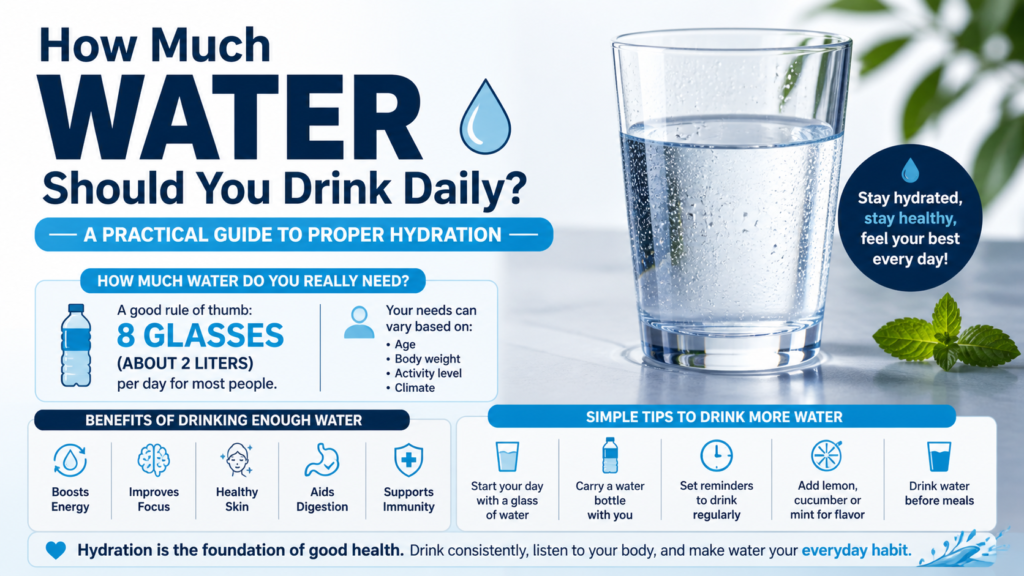
How Much Water Should You Drink Daily? A Practical Guide to Proper Hydration
Introduction: Is There Really a Perfect Amount?
You’ve probably heard the advice:
“Drink 8 glasses of water a day”
But here’s the:
There is no one perfect number that works for everyone.
Your water needs depend on:
- Your lifestyle
- Your activity level
- Your body type
- Your environment
In a country like India, where heat and humidity are common, hydration becomes even more important. The real goal is not to follow a fixed rule
It’s to understand what your body actually needs
“Water is the driving force of all nature.”
Why Your Body Needs Water More Than You Realize
Water is involved in almost every function of your body.
It helps:
- Regulate body temperature
- Support digestion
- Carry nutrients
- Remove toxins
What happens when you’re well-hydrated:
- Better energy
- Clearer skin
- Sharper focus
What happens with dehydration:
- Fatigue
- Headaches
- Low concentration
Even mild dehydration can affect how you feel and perform.
Understanding Your Daily Water Requirement
Let’s clear a common misconception:
“Everyone needs 8 glasses”
Reality: Hydration is personal
Your needs increase if you:
- Exercise regularly
- Spend time in the sun
- Live in a hot climate
- Eat salty or processed foods
Factors that affect your water intake:
- Body weight
- Metabolism
- Daily activity
- Weather conditions
Numbers are just guidelines
Your body gives better signals than any rule
Studies suggest:
Hydration needs vary significantly between individuals based on lifestyle and environment.
Signs Your Body Is Asking for More Water
Your body communicates dehydration clearly—you just need to notice.
Early signs:
- Feeling tired without reason
- Headaches
- Dry lips or skin
- Low energy
By the time you feel very thirsty, you may already be slightly dehydrated
Many people confuse dehydration with:
- Hunger
- Laziness
- Fatigue
But sometimes, your body simply needs water.
Hydration Through Food: More Than Just Drinking Water
Hydration doesn’t come only from water.
Water-rich foods include:
- Watermelon
- Oranges
- Cucumber
- Tomatoes
Indian-friendly options:
- Coconut water
- Buttermilk
- Fresh fruits
Real insight:
People who eat more fruits and vegetables often stay naturally hydrated without realizing it.
When and How You Drink Water Matters
Hydration is not just about quantity—it’s about timing and consistency.
What works best:
- Drink water throughout the day
- Start your morning with water
- Drink between meals
What to avoid:
- Drinking large amounts at once
- Ignoring thirst for long periods
Opinion:
Consistent hydration > forced overhydration
Simple habit:
Drink slowly instead of rushing—this helps your body absorb water better.
Real-Life Scenario
Let’s take a common example:
A working person:
- Drinks very little water
- Has multiple cups of tea/coffee
- Feels tired and unfocused
They assume:
- It’s stress
- It’s workload
After small changes:
- Starts drinking water regularly
- Adds fruits and coconut water
Within days:
- Energy improves
- Headaches reduce
- Focus becomes better
This is how hydration directly impacts daily life
Why “More Water” Is Not Always Better
Many people think:
“The more water I drink, the better”
But that’s not always true.
Overhydration can:
- Dilute electrolytes
- Cause discomfort
- Stress your system
Balance is more important than excess
Finding Your Personal Hydration Balance
Instead of counting glasses, observe your body.
Signs you are well-hydrated:
- Light-colored urine
- Stable energy
- No constant thirst
Signs you need more water:
- Dark urine
- Dryness
- Low energy
Your body is the best guide—learn to listen to it.
Conclusion: Listening to What Your Body Needs
Water is one of the simplest yet most powerful tools for better health. You don’t need strict rules or complicated plans. You need awareness and consistency.
By:
- Drinking regularly
- Eating water-rich foods
- Paying attention to your body
You can improve your energy, digestion, and overall well-being.
Because in the end:
Good health is not about following fixed rules—it’s about understanding your body.
Editorial Process
Our editorial process focuses on accuracy, clarity, and reader trust.
Health articles published on this website follow these principles:
- Research-based information from trusted medical sources
- Clear explanations written for general readers
- Regular updates when medical guidelines change
- Transparency about sources and references
Content is researched and written by health content researchers and reviewed using publicly available medical data.
Areas of focus include:
- infectious diseases
- preventive healthcare
- symptom awareness
- everyday health education
Medical Disclaimer
This article is for informational purposes only and does not replace professional medical advice. Always consult a qualified healthcare provider for diagnosis, treatment, or medical concerns.
Our Editorial & Trust Standards
At Healzeno, we aim to provide clear, responsible, and useful health information. Our content follows a structured editorial process:
Research → Writing → Fact-checking → Source verification → Editing → Publication → Periodic review
We aim to:
- Use reliable medical and public-health sources
- Avoid unsupported or misleading health claims
- Clearly distinguish general information from professional medical advice
- Update articles when important information changes
- Correct factual errors when identified
Healzeno is an independent health-information website and is not a medical clinic, hospital, or medical practice.
Why Trust Our Health Content
Our health articles are created using evidence-based information from globally recognized medical organizations. Each article is carefully researched using publicly available guidelines, research publications, and educational materials from trusted institutions such as the Centers for Disease Control and Prevention, the Mayo Clinic, the Cleveland Clinic, and the World Health Organization. Our goal is to present medical information in simple, easy-to-understand language so readers can make informed decisions about their health.

5 Comments