
Introduction: When the Mind Refuses to Rest
Night is meant for rest—but for many people, it becomes the loudest part of the day.
The moment everything gets quiet:
- Thoughts start racing
- Conversations replay
- Small worries feel bigger
This is not just “thinking too much”
It’s a mind that hasn’t found closure
Over time, this can lead to:
- Poor sleep
- Increased anxiety
- Morning fatigue
“A tired mind cannot find peace, only rest can.”
Why Overthinking Gets Worse at Night
During the day, your mind is distracted:
- Work
- Conversations
- Tasks
But at night:
All distractions disappear
What happens then:
- Unresolved thoughts come up
- Emotions surface
- Worries feel stronger
Strong insight:
Overthinking is not a problem
It’s your mind trying to process unfinished thoughts
Studies suggest:
Mental activity increases at night when external distractions reduce, making thoughts feel more intense.
Real-Life Scenario (Most Relatable)
Let’s take a common example:
A person finishes their day:
- Busy schedule
- No time to process emotions
At night:
- Lies in bed
- Starts thinking about past conversations
- Worries about future
Result:
- Sleep gets delayed
- Mind feels heavy
Truth:
The problem didn’t start at night—
It started during the day when thoughts were ignored
Creating a Calm Transition from Day to Night
One major reason for overthinking is:
Sudden shift from busy → silence
What works better:
Create a slow transition
- Dim lights
- Reduce screen time
- Slow down activities
Why it helps:
It signals your brain:
“It’s safe to relax now”
Strong opinion:
You don’t fix overthinking at night
You prevent it in the evening
Letting Thoughts Out Instead of Holding Them In
Overthinking happens when thoughts stay trapped in your mind.
Simple solution:
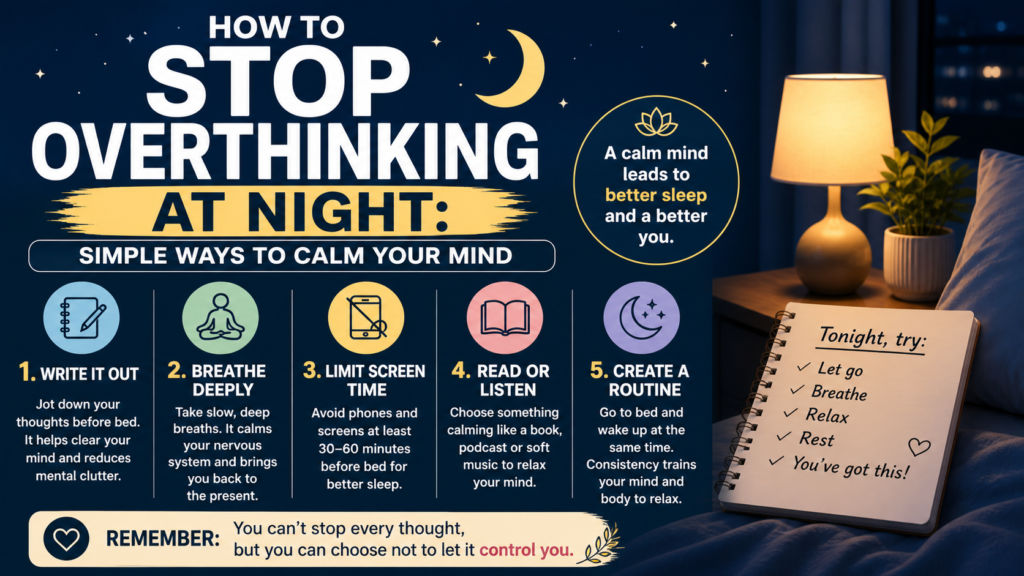
Write them down
- No structure needed
- No analysis needed
- Just express
Why it works:
- Reduces mental load
- Stops repetitive thinking
“Your mind feels lighter when your thoughts have a place to go.”
Rare insight:
Your brain keeps repeating thoughts because it thinks:
“This is important—don’t forget”
Writing it down gives it closure
The Power of Breathing and Stillness
When your mind races, your body becomes tense.
What helps:
- Slow breathing
- Sitting quietly for a few minutes
Why it works:
- Calms your nervous system
- Brings focus to the present
Simple technique:
Inhale slowly → Hold → Exhale slowly
Even 2–3 minutes can:
- Reduce anxiety
- Slow down thoughts
Reducing Mental Noise Before Bed
What you consume before sleep directly affects your mind.
Common mistakes:
- Scrolling social media
- Checking emails
- Watching intense content
This keeps your brain active even when you want to rest
What works instead:
- Light reading
- Calm music
- Quiet time
Strong truth:
Your mind cannot relax if you keep feeding it stimulation
Accepting Thoughts Instead of Fighting Them
Most people try to stop overthinking forcefully.
But this makes it worse.
Why?
The more you resist a thought:
The stronger it becomes
Better approach:
- Observe thoughts
- Don’t react
- Let them pass
Rare insight:
Thoughts lose power when you stop fighting them
Building a Night Routine That Supports Peaceful Sleep
Your brain loves patterns.
A consistent night routine creates:
- Safety
- Predictability
- Calmness
Simple routine:
- Fixed sleep time
- No screens before bed
- Quiet environment
Over time, your mind learns:
“This is time to rest”
Strong Truth Most People Ignore
Overthinking is not the real problem
The real issue is:
- Unprocessed thoughts
- Lack of mental breaks
- Constant stimulation
Fix these—and overthinking reduces naturally
Conclusion: Finding Quiet Within the Noise
Overthinking at night is something many people experience—but it doesn’t have to control you.
By:
- Slowing down your evenings
- Expressing your thoughts
- Creating calm habits
You can train your mind to rest
Because in the end:
Peace is not about having no thoughts—
It’s about not being controlled by them.
Author
Healzeno Health Team
This article is written and reviewed based on mental wellness insights, behavioral patterns, and general lifestyle research.
Disclaimer
This content is for informational purposes only and should not be considered medical or psychological advice. If symptoms persist, consult a qualified professional.
Author & Trust Signals
Last Updated: April 11, 2026
Author
Written by: Bunty | Health Content Researcher
Bunty is a health content researcher who focuses on explaining medical topics in clear, practical language for everyday readers. His work involves studying publicly available health guidelines and medical information from trusted organizations such as the Centers for Disease Control and Prevention, the World Health Organization, and the Mayo Clinic.
His goal is to make complex health information easier to understand so readers can recognize early symptoms, learn prevention strategies, and know when medical attention may be necessary.
Areas of focus include:
- infectious diseases
- preventive healthcare
- symptom awareness
- everyday health education
Editorial Process
Our editorial process focuses on accuracy, clarity, and reader trust.
Health articles published on this website follow these principles:
- Research-based information from trusted medical sources
- Clear explanations written for general readers
- Regular updates when medical guidelines change
- Transparency about sources and references
Content is researched and written by health content researchers and reviewed using publicly available medical data.
Medical Disclaimer
This article is for informational purposes only and does not replace professional medical advice. Always consult a qualified healthcare provider for diagnosis, treatment, or medical concerns.
Why Trust Our Health Content
Our health articles are created using evidence-based information from globally recognized medical organizations. Each article is carefully researched using publicly available guidelines, research publications, and educational materials from trusted institutions such as the Centers for Disease Control and Prevention, the Mayo Clinic, the Cleveland Clinic, and the World Health Organization. Our goal is to present medical information in simple, easy-to-understand language so readers can make informed decisions about their health.
References
Information in this article is based on educational resources and guidelines from trusted medical organizations including:
- Centers for Disease Control and Prevention
- Mayo Clinic
- Cleveland Clinic
- Medical News Today
- World Health Organization
