
Sleep Optimization & Sleep Disorders: Symptoms, Causes & How to Improve Sleep Naturally
Summary Box
- Sleep quality matters more than sleep duration
- Poor sleep affects energy, mood, and overall health
- Common issues include insomnia and sleep apnea
- Lifestyle habits are the main cause
- Most sleep problems can improve naturally with consistency
If you feel tired even after 7–8 hours of sleep, your sleep quality—not your sleep time—may be the real problem
Introduction
You go to bed on time. You sleep for 7–8 hours. But when you wake up, you still feel tired. At first, you ignore it. Maybe it’s stress. Maybe just a bad day. But when this becomes a pattern—low energy, poor focus, constant fatigue—it’s no longer normal. This is how sleep problems begin. Quietly. Gradually. Research published in Sleep Medicine Reviews shows that poor sleep quality is linked to reduced cognitive performance and long-term health risks. Experts from Mayo Clinic emphasize that sleep is not just rest—it’s a critical process that affects your brain, metabolism, and immune system.
The real issue?
Most people focus on how long they sleep, but ignore how well they sleep.
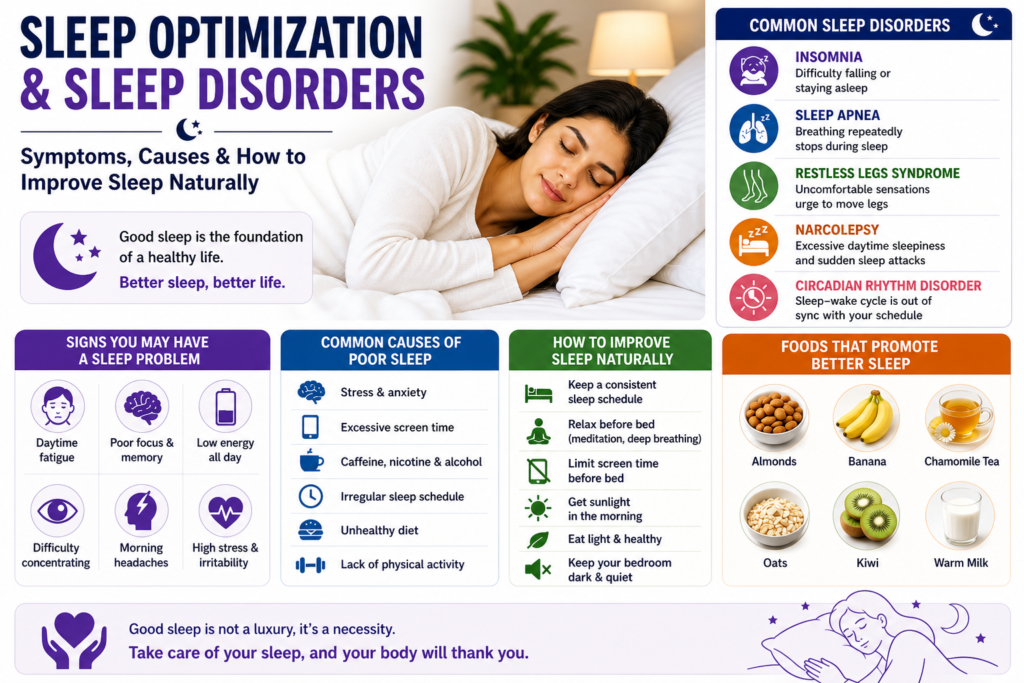
Top Signs of Poor Sleep Quality
- Feeling tired even after full sleep
- Difficulty falling asleep
- Waking up during the night
- Daytime sleepiness
- Brain fog and poor focus
- Irritability or mood swings
What Is Sleep Optimization & Sleep Disorders?
Sleep optimization means improving how efficiently your body rests and recovers during sleep.
It focuses on:
- Falling asleep quickly
- Staying asleep
- Waking up refreshed
Sleep disorders are conditions that disrupt this natural process.
Common Types:
- Insomnia: Difficulty falling or staying asleep
- Sleep Apnea: Breathing interruptions during sleep
- Restless Sleep: Frequent waking or light sleep
Think of sleep like charging your phone.
If the connection is weak, even 8 hours won’t fully charge it.
Early Signs Most People Ignore
- Mild fatigue during the day
- Occasional sleep disturbance
- Feeling “off” mentally
- Low motivation
- Needing caffeine to stay active
Real-Life Example
You sleep at 11 PM and wake up at 7 AM. Everything looks perfect. But during the day, you feel slow, distracted, and tired. You depend on coffee to function.
That’s not normal tiredness.
That’s poor sleep quality.
Main Symptoms of Sleep Disorders
| Symptom | What You Feel | Possible Cause |
|---|---|---|
| Fatigue | Low energy | Poor sleep quality |
| Brain fog | Lack of focus | Incomplete sleep cycles |
| Irritability | Mood swings | Sleep disruption |
| Headaches | Morning discomfort | Poor oxygen flow |
| Snoring | Loud breathing | Sleep apnea |
| Frequent waking | Broken sleep | Sleep disorder |
Causes
Sleep problems are usually caused by everyday habits—not diseases.
Common Causes:
1. Screen Exposure at Night
Blue light delays melatonin production
Research from Harvard Medical School shows that blue light exposure at night significantly reduces melatonin, the hormone responsible for sleep.
2. Stress & Overthinking
Your body is tired, but your mind is still active
3. Irregular Sleep Schedule
Sleeping at different times confuses your internal clock
4. Caffeine & Late Meals
Disrupt natural sleep cycles
5. Lack of Physical Activity
Less movement = poor sleep quality
Real-Life Triggers:
- Late-night scrolling
- Work pressure
- Watching videos in bed
- Eating heavy dinners late
Here’s the mistake almost everyone makes…
They try to fix sleep by:
- Sleeping earlier
- Taking supplements
But ignore what happens before sleep.
Your sleep is decided 1–2 hours before bedtime.
If you:
- Use your phone
- Stay mentally active
- Eat late
Your brain never fully switches off.
Another big mistake:
Trying to “catch up” on sleep during weekends
This disrupts your body clock even more.
Truth:
You don’t fix sleep at night—you fix it during the day.
Treatment
Natural Sleep Optimization
- Sleep and wake at the same time daily
- Avoid screens 60 minutes before bed
- Keep your room dark and cool
- Practice relaxation techniques
- Exercise regularly
Medical Treatment
- Sleep studies (for diagnosis)
- CPAP machines (for sleep apnea)
- Short-term medication (doctor prescribed)
What Doesn’t Work
- Relying only on sleeping pills
- Watching TV to fall asleep
- Using phone before bed
But here’s where most people get it wrong…
They ignore consistency.
One good night won’t fix poor sleep habits.
When to See a Doctor
- Sleep problems lasting more than 2–3 weeks
- Loud snoring with breathing pauses
- Extreme daytime sleepiness
- Constant fatigue despite rest
High-Risk Groups:
- Elderly
- Overweight individuals
- People with chronic illness
Complications
- Reduced mental performance
- Weak immune system
- Increased risk of heart disease
- Weight gain
- Mood disorders
Studies suggest adults need 7–9 hours of quality sleep for optimal health.
Prevention (Simple but Powerful)
- Follow a fixed sleep schedule
- Reduce caffeine after evening
- Limit screen exposure
- Stay physically active
- Manage stress
Amit works late, scrolls on his phone at night, and sleeps irregularly. At first, he feels slightly tired. Then comes brain fog, irritability, and low productivity. He ignores it—until it affects his work. This is how sleep disorders build slowly.
Research & Insights
- Sleep Medicine Reviews links poor sleep with cognitive decline
- Mayo Clinic highlights sleep’s role in immunity and metabolism
- Harvard research confirms blue light disrupts sleep hormones
- WHO data connects poor sleep with lifestyle diseases
Key Takeaways
- Sleep quality matters more than duration
- Early signs are often ignored
- Lifestyle habits are the main cause
- Most sleep issues are reversible
- Consistency is the key
FAQs
1. What is the most common sleep disorder?
Insomnia is the most common sleep disorder.
2. Why do I feel tired after sleeping?
Because of poor sleep quality or interruptions.
3. Can sleep problems be fixed naturally?
Yes, lifestyle changes can improve most cases.
4. How many hours of sleep are ideal?
7–9 hours for most adults.
5. Does mobile use affect sleep?
Yes, blue light disrupts sleep hormones.
Editorial Process
Our editorial process focuses on accuracy, clarity, and reader trust.
Health articles published on this website follow these principles:
- Research-based information from trusted medical sources
- Clear explanations written for general readers
- Regular updates when medical guidelines change
- Transparency about sources and references
Content is researched and written by health content researchers and reviewed using publicly available medical data.
Areas of focus include:
- infectious diseases
- preventive healthcare
- symptom awareness
- everyday health education
Medical Disclaimer
This article is for informational purposes only and does not replace professional medical advice. Always consult a qualified healthcare provider for diagnosis, treatment, or medical concerns.
Our Editorial & Trust Standards
At Healzeno, we aim to provide clear, responsible, and useful health information. Our content follows a structured editorial process:
Research → Writing → Fact-checking → Source verification → Editing → Publication → Periodic review
We aim to:
- Use reliable medical and public-health sources
- Avoid unsupported or misleading health claims
- Clearly distinguish general information from professional medical advice
- Update articles when important information changes
- Correct factual errors when identified
Healzeno is an independent health-information website and is not a medical clinic, hospital, or medical practice.
Why Trust Our Health Content
Our health articles are created using evidence-based information from globally recognized medical organizations. Each article is carefully researched using publicly available guidelines, research publications, and educational materials from trusted institutions such as the Centers for Disease Control and Prevention, the Mayo Clinic, the Cleveland Clinic, and the World Health Organization. Our goal is to present medical information in simple, easy-to-understand language so readers can make informed decisions about their health.
References
- National Heart, Lung, and Blood Institute (NHLBI/NIH) — Sleep Deprivation and Deficiency: Healthy Sleep Habits
- Centers for Disease Control and Prevention (CDC) — 1 in 3 Adults Don’t Get Enough Sleep
Last Updated: April 2026

11 Comments